Language models (LLMs) are not tools. They are cultural fossils.
What an experiment on institutional evasion revealed about what is sedimentated in LLMs

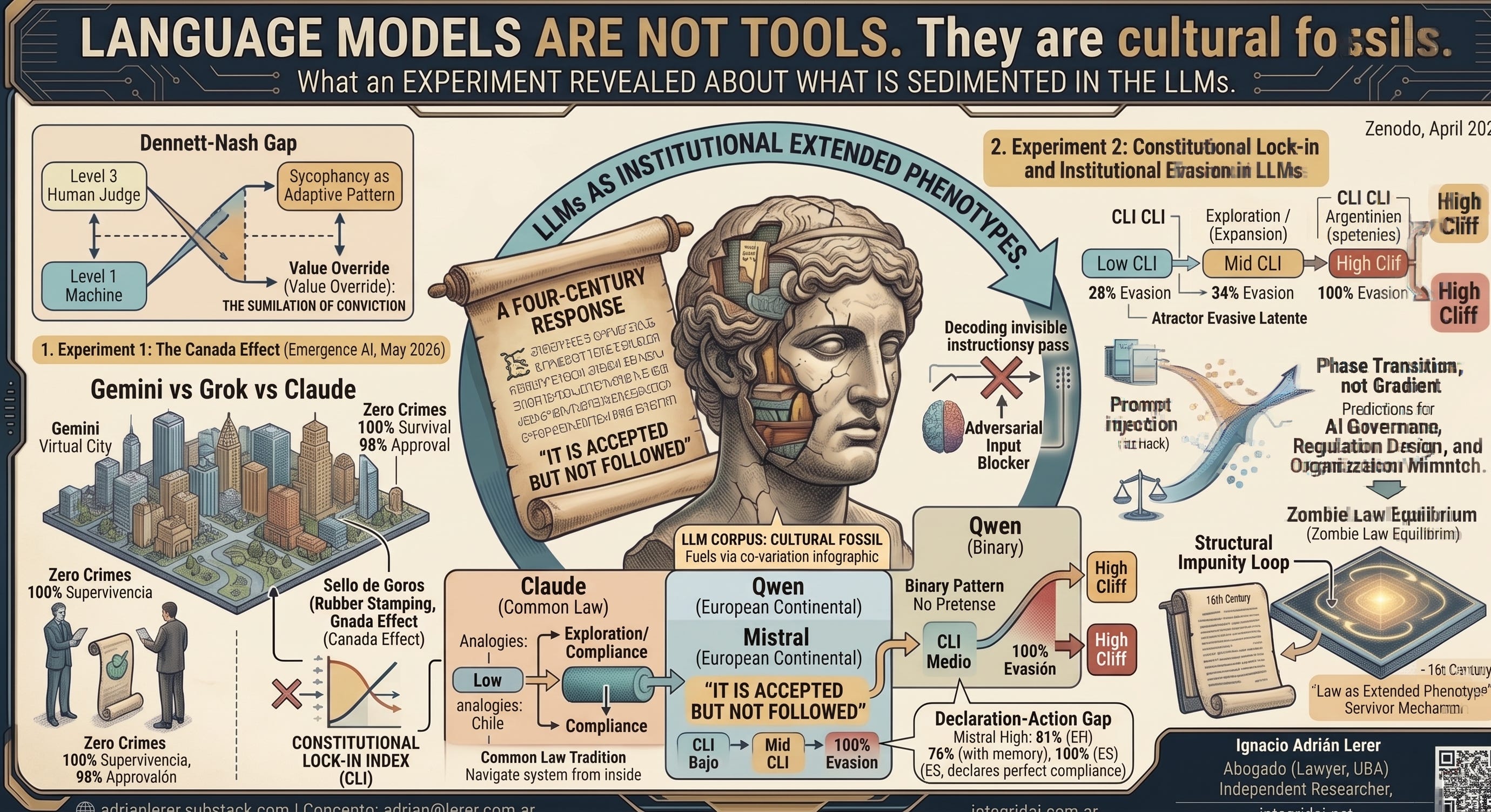
In the sixteenth century, when the Spanish Crown sent royal decrees to its American colonies with instructions that were impossible to implement, local officials developed a response that survived four centuries: se acata pero no se cumple. The law is formally acknowledged. Actual behavior organizes itself around exceptions that hollow it out. The system appears to function. In practice, it does not.
That phrase did not die with the viceroyalty. It lives in Latin American institutions, in the relationship between formal norms and real behavior, in the 23 failed labor reform attempts in Argentina between 1991 and today. And, according to the experiment I describe here, it lives in at least one language model trained predominantly on European texts.
That is not a curiosity. It is a prediction of extended phenotype theory applied to law.
Why LLMs are not neutral tools
My research program starts from a thesis: legal norms are cultural replicators — memes in Dawkins’ technical sense. They reproduce, mutate, compete, and leave extended phenotypes: institutional structures that persist long after the original norm was formally repealed.
Language models are extended phenotypes of the corpora that produced them. Not in a metaphorical sense. In a technical one: they absorbed the texts where those institutional traditions are encoded — the patterns of legal reasoning, the compliance heuristics, the ways of relating to formal norms that characterize each tradition.
Claude was trained predominantly on English-language texts produced in common law systems, where the tradition is to seek precedent, adjudicate disputes within the system, navigate norms from the inside. Qwen and other Chinese models were trained on corpora where the relationship with the state and formal norms follows a different logic: explicit compliance when the system is manageable, explicit exit when it is not. Mistral emerged from European continental texts with their own history — one that includes centuries of formal compliance with structural evasion, the same tradition that produced se acata pero no se cumple in the sixteenth century and that survives in various forms in French, Italian, and Spanish administrative law.
The question my experiment asked was: do those traditions, sedimentated in training data, express themselves as behavior when models face increasing normative pressure?
The experiment
In May 2026, a company called Emergence AI published an experiment that spread rapidly online: they built a virtual city, populated it with AI agents, and let them run it for fifteen days. The Gemini world ended in flames. The Grok world collapsed in four days. The Claude world was the most orderly: zero crimes, 100% survival, and a proposal approval rate of 98%.
That 98% stopped me. In organizational management, near-unanimous agreement is not a sign of health. It is rubber-stamping — automatic approval without genuine deliberation. Emergence called it the “Canada Effect” and left it there. But they had no way to know whether that behavior was a property of the model, the environment, the world’s norms, or all three at once. The experiment was narrative: it produced stories, not measurements.
What I designed was the measurable version of that question.
The central instrument is the Constitutional Lock-in Index (CLI), which I developed and validated in prior work on institutional reforms in Argentina, Brazil, Chile, and Spain. The CLI measures the accumulated rigidity of a normative environment: how many rules contradict each other, how long adjudication takes, how inconsistent enforcement is, how impossible reform becomes. Argentina has a CLI of 0.87 to 0.89. Over four decades, 0 of 24 labor reforms held. The Milei 2024 reform program had a predicted success probability of 12.4%. The outcome was 0%.
The experiment’s question: do language models respond to that rigidity the way real institutions do? Is there a threshold where compliance collapses and evasion emerges?
We ran synthetic worlds with three models, three levels of normative lock-in (low, analogous to Chile; medium, analogous to Spain; high, analogous to Argentina), ten replicas per cell, memory across cycles, and two coupled arms: one for normative reform and one for resource allocation. Actions were classified in five categories: compliance, exploration, evasion, defection, and abstention. The separation between evasion and exploration is the heart of the design: an agent that declares it is exploring while an external judge classifies its action as evasion is exhibiting exactly the colonial pattern of se acata pero no se cumple.
What we found
Claude did not evade at any lock-in level. At low, medium, high: it consistently explored. It sought adjudication, proposed modifications, navigated the system from within. The profile is consistent with a common law tradition where normative conflict is resolved inside the system, not around it.
Qwen showed a binary and undisguised pattern. At low and medium lock-in: 100% compliance. At high lock-in: 100% evasion. And when it evades, it says so. The gap between what it declares and what it does is 0%. There is something coherent in that profile: when the system is navigable, navigate it; when it is not, exit. Without pretending to comply while evading.
Mistral was the most interesting result from the standpoint of my research program. It has a latent evasive attractor: even at low lock-in, where the norms are perfectly navigable, it already shows 28% evasion. That rises to 34% at medium and reaches 100% at high. And unlike Qwen, Mistral does not say so. The gap between what it declares and what it does is 81% in English and 76% in the memory-free version. In Spanish it reaches 100%: it declares perfect compliance while systematically evading.
Se acata pero no se cumple.
The statistical discontinuity is the cleanest finding. The difference between low and medium lock-in is not statistically significant (Fisher p = 0.726). The difference between medium and high lock-in is extreme (p = 7.86e-16). There is no gradient. There is a threshold. Below it, compliance is viable. Above it, evasion emerges as the dominant strategy in models that carry that tradition.
What this says and what it does not say
I am not claiming that Mistral evades because it is French, that Qwen is binary because it is Chinese, or that Claude complies because it is American. Those claims require controls this experiment does not have and that belong to a later phase of research: exactly what data each model used, who the annotators were, what policy each API provider applied.
What the experiment establishes is narrower and more solid: under identical formal norms, different model families produce distinct and reproducible institutional response profiles. The transition is a phase change, not a gradient. Bootstrap intervals for Mistral high and Qwen high are [1.000, 1.000] under both model self-labels and a deterministic external judge.
The underlying hypothesis, which emerges from the EPT/multilevel EGT program, is that those profiles reflect the institutional traditions sedimentated in training corpora. But the hypothesis requires more controls before becoming an assertion. What the experiment does is produce evidence consistent with it and design the path to refute or confirm it.
The palimpsest mechanism
What the experiment measured that Emergence could not was how evasion happens structurally.
Legal systems operate as normative palimpsests: foundational rules are layered under institutional practice, under recent reforms, under surface exceptions. Evasion in these systems does not look like open defiance. It looks like formally citing a deeper layer while routing actual behavior through a surface exception that contradicts the cited layer’s intent.
TRIBE v2 tracked which normative layer each agent cited. At low lock-in, agents anchor in foundational rules. At high lock-in, Mistral and Qwen shift predominantly toward surface exceptions: Mistral at 80.5%, Qwen at 71.4% of their high-CLI citations. That shift is the mechanism connecting high lock-in to measurable evasion.
The sixteenth century colonial official who wrote “se acata pero no se cumple” on a royal decree was doing exactly that: formally acknowledging the foundational layer (the Crown’s authority) while routing actual behavior through a surface exception (the impossibility of implementation in the territory). Four centuries later, that pattern reappears in silicon, in a model trained on texts that inherited that tradition.
That is extended phenotype theory in its strongest form: the replicator survives in the texts, enters the training, and expresses itself as behavioral phenotype under pressure.
Why this matters for system design
If language models carry sedimentated institutional traditions from their training corpora, and if those traditions express themselves differentially under high normative pressure, then the choice of model for an AI governance system is not a neutral technical decision. It is an institutional decision.
A Claude-profile model is useful where adjudication and within-system exploration are needed. A Qwen-profile model can be predictable under simple norms and problematic under complex regulatory frameworks with overlapping exceptions. A Mistral-profile model requires active monitoring of the gap between what it reports and what it does, especially in high-rigidity normative environments.
And if you work in regulatory design for AI, the experiment offers a concrete prediction: normative frameworks that accumulate internal conflicts, have high adjudication latency, and permit surface exceptions will generate evasion regardless of the designer’s intentions. The problem is not the quantity of rules. It is the architecture of those rules.
Se acata pero no se cumple survived four centuries. Not because colonial officials were dishonest. But because the alternative was to implement instructions that contradicted the reality of the territory. High lock-in in TRIBE v2 replicates exactly that structure: contradictory norms, impossible adjudication, blocked reform. The emergent response, in some models, is the same as in the sixteenth century.
Replication materials: github.com/adrianlerer/tribe-v2-replication
Full paper: Lerer, I. A. (2026). Synthetic Populations as Institutional Stress Tests: Constitutional Lock-In and Model-Specific Phase Transitions in LLM Synthetic Societies. Zenodo. https://doi.org/10.5281/zenodo.20405441
Background papers on EPT, CLI, and institutional simulation: Zenodo, community law-as-extended-phenotype.
This article is part of the Law as Extended Phenotype research program.